
策劃資本市場的卓越開局:企業赴美上市的戰略預備與價值構建
策劃資本市場的卓越開局:企業赴美上市的戰略預備與價值構建
在當前波動與機遇並存的全球資本環境下,赴美首次公開募股(IPO)絕非單純的融資行為,而是一場對企業治理架構與商業邏輯的全面重塑。市場實務證明,最終敲鐘的榮光僅是冰山一角,真正的勝負手早在啟動前的兩至三年便已定調。
許多企業主常陷入一種路徑誤區,將上市簡化為招攬投行、遞交文件與掛牌交易的線性流程。然而,缺乏深厚積澱的匆促上市,往往導致估值折價,甚至在最後關頭折戟沉沙。站在頂尖投資銀行的專業視角,企業必須從以下三個核心維度深耕,方能確保在資本市場的長期成功。
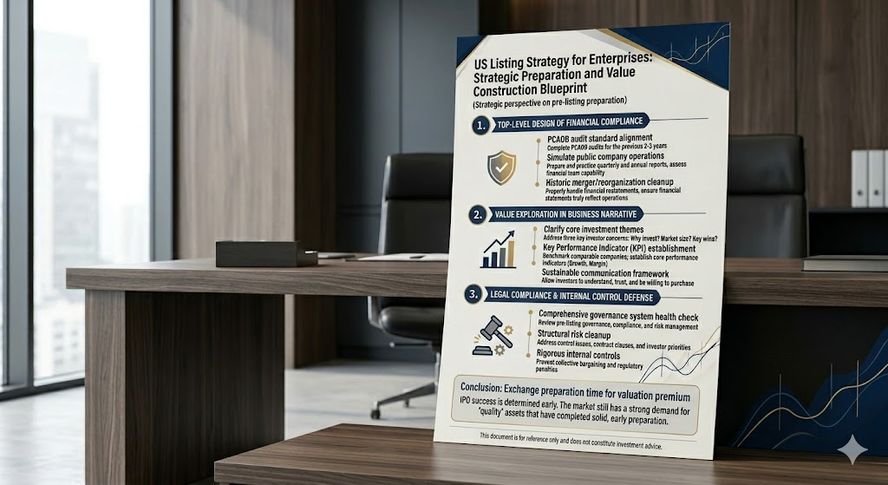
一、財務合規的頂層設計:從會計準則到透明度轉型
對於私有企業而言,財務報表僅是經營的記錄,但對於上市公司,財報則是與全球投資者對話的核心語言。私營階段的 GAAP 準則已不足以應對公開市場的檢閱,企業必須全面對齊 PCAOB 的審計標準,並應對 SEC 嚴苛的披露要求。
審計質量的超前部署:建議企業在正式遞表前 2 至 3 年,即開始按 PCAOB 標準編製財報。這不僅是為了滿足法規,更是為了積累關鍵會計判斷的論證材料(如白皮書),以應對審查。
模擬運營與流程再造:在私有階段即應啟動「模擬上市公司運作」。企業需按照 SEC 規定的節奏演練季報與年報披露,梳理結賬流程,並評估現有財務團隊是否有能力應對高強度的公開市場溝通。
歷史遺留問題的戰略清理:針對過往的併購、剝離或組織重組,企業需精確處理財務重述問題,確保歷史數據的連續性與真實性。更重要的是提升財務預測的精準度,避免上市後因業績指引(Guidance)與實際表現偏差過大而喪失市場公信力。
二、商業敘事的價值挖掘:構建不可替代的增長邏輯
在全球投資者的資產配置庫中,企業必須回答三個根本性問題:「核心投資價值為何?」、「市場天花板在哪?」以及「競爭壁壘如何持續?」
對標與定位:企業需深入分析可比上市公司(Comp Group),在展現自身高增長性與稀缺性的同時,確立關鍵績效指標(KPI)。無論是利潤率、客戶留存率還是技術領先度,都必須轉化為資本市場聽得懂、能驗證的語言。
可持續的對話框架:成功的 IPO 敘事不僅關乎過去的成就,更在於上市後可持續發展的故事線。企業需建立一套清晰的溝通框架,確保投資者在瞬息萬變的市場中,仍能對企業的長期願景保持「看得懂、信得過、願意買」的信心。
三、法律合規與內控防禦:守護上市地位的隱形資產
上市意味著企業將暴露在最高強度的公眾監督與法律義務之下。完善的合規體系不只是為了應付盡職調查,更是保護企業免受集體訴訟與監管處罰的防波堤。
治理體系的全面體檢:在正式進入市場前,企業必須建立嚴謹的內部控制(Internal Controls)與風險管理機制。法律盡職調查應涵蓋合同條款、知識產權、數據隱私及員工股權激勵等多個層面。
結構性的風險排除:特別需留意歷史融資協議中的「控制權變更」觸發條款,以及現有投資者的優先權安排。這些細節若處理不當,可能直接衝擊上市架構的合法性與穩定性。
結語:以時間換取估值溢價
IPO 的成功,是企業多年累積的必然結果,而非臨場發揮的偶然。雖然當前市場對優質資產保持高度渴望,但投資者對「優質」的定義已愈發嚴苛。唯有提前紮實完成財務、業務與合規的全方位準備,企業才能在國際資本舞臺上,實現從「融資者」向「市場領導者」的華麗轉身。
.png)
Orchestrating Capital Market Excellence: Strategic Readiness and Value Creation for U.S. Listings
In a global capital landscape defined by simultaneous volatility and opportunity, a U.S. Initial Public Offering (IPO) is far more than a mere capital-raising exercise; it is a fundamental transformation of a corporate governance framework and business logic. Market practice demonstrates that the prestige of the opening bell is merely the tip of the iceberg—the true outcome is decided two to three years before the launch.
Many issuers fall into the "pathway fallacy," oversimplifying the IPO into a linear process of hiring underwriters, filing documentation, and listing. However, a rushed debut lacking deep institutional preparation often results in a valuation discount or, in the worst cases, a failed offering. From the perspective of a premier investment bank, an enterprise must cultivate excellence across three core dimensions to ensure long-term success in the public markets.
I. Architectural Design of Financial Compliance: From Reporting to Transparency
For private companies, financial statements are records of operations; for public companies, they are the primary language for engaging with global institutional investors. Private-stage accounting standards are insufficient for public market scrutiny; issuers must fully align with PCAOB (Public Company Accounting Oversight Board) audit standards and navigate the rigorous disclosure mandates of the SEC.
Pre-emptive Audit Quality Enhancement: We recommend that enterprises begin preparing financial statements under PCAOB standards 24 to 36 months prior to the formal filing. This is not merely a regulatory box-ticking exercise but a strategic move to build a repository of "white papers" defending critical accounting judgments.
Operational Simulation and Process Re-engineering: Transitioning to a "public-ready" state involves dry-running quarterly and annual reporting cycles according to SEC timelines. This includes streamlining closing processes and stress-testing the finance team’s ability to manage high-intensity market communications.
Strategic Resolution of Legacy Issues: Issuers must meticulously address financial restatements arising from past M&A, carve-outs, or reorganizations to ensure data continuity and integrity. Furthermore, refining Financial Forecasting capabilities is critical to avoid "earnings misses" post-IPO, which can instantly erode market credibility.
II. Excavating the Investment Narrative: Constructing Irreplaceable Growth Logic
To earn a place in a global investor's portfolio, an issuer must provide definitive answers to three fundamental questions: "What is the core investment thesis?", "What is the total addressable market (TAM)?", and "How sustainable is the competitive moat?"
Benchmarking and Positioning: Through deep analysis of the Comparable Group (Comps), the enterprise must articulate its high-growth potential and scarcity value. Key Performance Indicators (KPIs)—whether margins, retention rates, or technological alpha—must be translated into a validated language that the capital market trusts.
Sustainable Engagement Framework: A successful IPO narrative extends beyond historical milestones to an enduring "equity story." Issuers must establish a transparent communication framework that instills conviction in investors—ensuring they understand the vision, trust the management, and are committed to the long-term hold.
III. Legal Fortification and Internal Controls: Protecting the "Invisible Assets"
Public status exposes a company to peak levels of regulatory oversight and fiduciary liability. A robust compliance ecosystem is not just for clearing Due Diligence; it is a defensive bulwark against class-action litigation and regulatory sanctions.
Corporate Governance Health Check: Prior to market entry, rigorous Internal Controls (ICFR) and risk management mechanisms must be institutionalized. Legal due diligence must comprehensively cover contractual obligations, Intellectual Property (IP), data privacy, and equity incentive schemes.
Structural De-risking: Specific attention must be paid to "Change of Control" triggers in legacy financing agreements and the liquidation preferences of existing investors. Failure to remediate these complexities can jeopardize the legality and stability of the listing structure.
Conclusion: Trading Preparation Time for Valuation Premium
The success of an IPO is the inevitable result of years of institutional discipline, not a stroke of situational luck. While global appetite for "quality assets" remains strong, the definition of "quality" has become increasingly stringent. Only by rigorously executing on financial, operational, and legal readiness can an enterprise achieve the prestigious transition from a "private seeker of funds" to a "public market leader."
https://www.ivy-service.com
- 1
- 2
- 3
- 4


