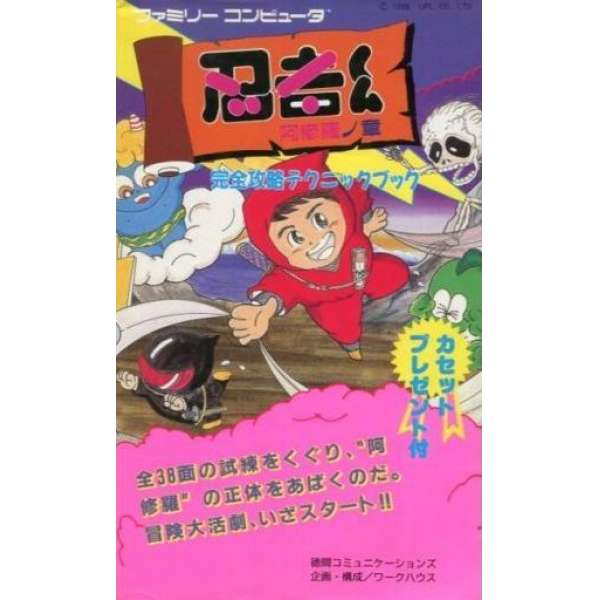
FC 忍者君 阿修羅之章 完全攻略
《忍者君:阿修羅之章》於1988年5月27日在Family Computer(FC/紅白機)平台推出,由UPL開發,並由HAL研究所(HAL Laboratory)移植至家用主機,是《忍者君》系列的第二部作品。與前作相比,在遊戲系統上進行大幅創新,徹底打破單一畫面的限制,實現當時極為罕見的「全方位捲軸」冒險。結合物理慣性、多樣化武器切換以及充滿詭譎妖怪氣息的世界觀,使其在8位元時代的忍者遊戲中獨樹一格。
遊戲技術上,這是一款全方位捲軸的先驅之作。關卡不再僅限水平移動,而是涵蓋大量垂直攀爬、水下潛行以及斜向探索。玩家操控的小忍者具備細膩動作模組,包括牆壁反彈跳、水中划行及重力加速墜擊。場景設計融合日本傳統神怪與奇幻元素,從幽暗森林、岩漿地獄到充滿機械陷阱的城池,發色數與細節在當時均屬上乘。
故事承接前作傳奇,主角小忍者「忍者君」得知邪惡鬼王「阿修羅」甦醒,率領妖怪大軍企圖將人間化為煉獄。為守護世界和平,忍者君必須橫跨三十個以上關卡,深入妖怪大本營。沿途玩家將面對河童、天狗、骨龍等東方妖魔,並挑戰體型巨大的BOSS。最終,忍者君將逐一擊敗阿修羅的左右手,直至挑戰地獄深處的阿修羅本人。
操作上,強調慣性與工具應用的操控美學。可使用多樣化武器系統,擊敗特定敵人可獲取火炎瓶、炸彈或三向散開的鐮刀,每種武器針對不同妖怪效果不同,需靈活切換。遊戲特色還包括「踩頭」暈眩機制,玩家從高處踩在敵人頭上時,敵人會短暫昏迷,提供補擊或踢飛的機會,使戰鬥充滿節奏感。遊戲地形充滿懸崖與水域挑戰,需運用牆壁反彈進行連續跳躍,才能探索隱藏路徑。
市場評價方面,在專業圈中獲得極高評價,特別在硬派動作遊戲玩家間被奉為經典。評論家讚賞其動作豐富度與全方位移動、武器切換的流暢性,HAL研究所的移植確保打擊感和音樂表現。然而,本作難度極高,敵人密集且判定嚴苛,新手常在同一關卡受挫,但對追求操作細節與物理慣性的玩家而言,它被公認為8位元時代最具「操作靈魂」的忍者遊戲之一。這款遊戲成功將街機高密度戰鬥感帶入家用平台,並為後續動作遊戲的地形互動與武器切換設計提供寶貴啟發。
Ninja-kun: Ashura no Shou was released on May 27, 1988, for the Family Computer (FC/NES) platform. Developed by UPL and ported to home consoles by HAL Laboratory, it is the second installment in the Ninja-kun series. Compared to its predecessor, this title introduced significant innovations, breaking free from the single-screen limitation and offering a rare “full-scroll” adventure for its time. Its combination of realistic inertia physics, diverse weapon-switching mechanics, and a bizarre, yokai-infested world made it stand out among ninja games of the 8-bit era.
Technically, Ninja-kun: Ashura no Shou is a pioneering full-scroll action game. Levels are no longer limited to horizontal movement; instead, they include extensive vertical climbing, underwater traversal, and diagonal navigation. The player-controlled ninja has a highly detailed movement system, including wall rebounds, swimming maneuvers, and gravity-accelerated drops. The game’s environments merge traditional Japanese yokai aesthetics with fantasy elements, ranging from shadowy forests and lava-filled hellscapes to mechanically trapped castles, with exceptional color depth and detail for its time.
The story continues the legend of the previous game. The young ninja protagonist, “Ninja-kun,” learns that the evil demon king Ashura has awakened and commands a massive army of yokai to transform the human world into a living hell. To preserve peace, Ninja-kun must traverse over thirty perilous stages and infiltrate the yokai stronghold. Along the way, players face traditional Japanese monsters such as kappa, tengu, and skeletal dragons, culminating in battles against massive bosses. Ultimately, Ninja-kun must defeat Ashura’s lieutenants and confront Ashura himself in the depths of hell.
Gameplay emphasizes inertia-based controls and tool utilization. The game features a diverse weapon system: defeating specific enemies allows Ninja-kun to acquire long-range fire bombs, penetrating explosives, or three-way scythe attacks. Each weapon interacts differently with certain enemies, requiring strategic switching. A notable mechanic is the “stomp” stun: jumping from above onto an enemy’s head temporarily incapacitates them, allowing for follow-up attacks or a kick-away, creating a rhythmic combat flow. Level design challenges the player with cliffs, water sections, and precise platforming, often requiring wall rebounds to access hidden paths.
Critically, Ninja-kun: Ashura no Shou received high praise, especially among hardcore action game enthusiasts, and is regarded as a classic. Reviewers highlighted its rich action variety, fluid full-scroll movement, and responsive weapon switching. HAL Laboratory’s port preserved strong impact feedback and a fitting soundtrack. However, the game’s high difficulty, dense enemy placement, and strict collision detection posed challenges for new players. Despite this, for players who enjoy mastering movement mechanics and physics-based combat, it is considered one of the most mechanically “soulful” ninja games of the 8-bit era. The title successfully brought arcade-style high-density combat into home consoles and provided valuable design inspiration for later action games in terrain interaction and weapon-switching mechanics.
運費計算方式:
貨款滿1000元運費外加90元
貨款1000以下:買1件運費外加 60元,買2件運費外加 70元,
買3件運費外加 80元 ,買4件運費外加 90元
貨到付款外加30元手續費
外島及大陸地區運費另計
付款方式:
線上刷卡:本站採用Paypal線上刷卡
虛擬帳號匯款:屬於您專屬的虛擬帳戶,方便站長查帳使用,本站強力推薦
實體ATM匯款:請將匯款帳號記錄下來至各大銀行ATM提款機轉帳
超商條碼繳費:請列印本站提供的條碼至四大超商繳費
線上轉帳:透過玉山銀行線上ATM轉帳(此系統只支援IE瀏覽器)
貨到付款:本站採用黑貓宅急便貨到付款
其他注意事項:
如需購買線上點數卡請直接跟站長連絡,本站不提供點數卡的線上付款
-
FC 忍者君 阿修羅之章 完全攻略
- 定 價:
- 售 價: 0.00
- 庫存量: 0 套
- 已賣出: 0 套
 人氣指數: 0 / 6 顆星