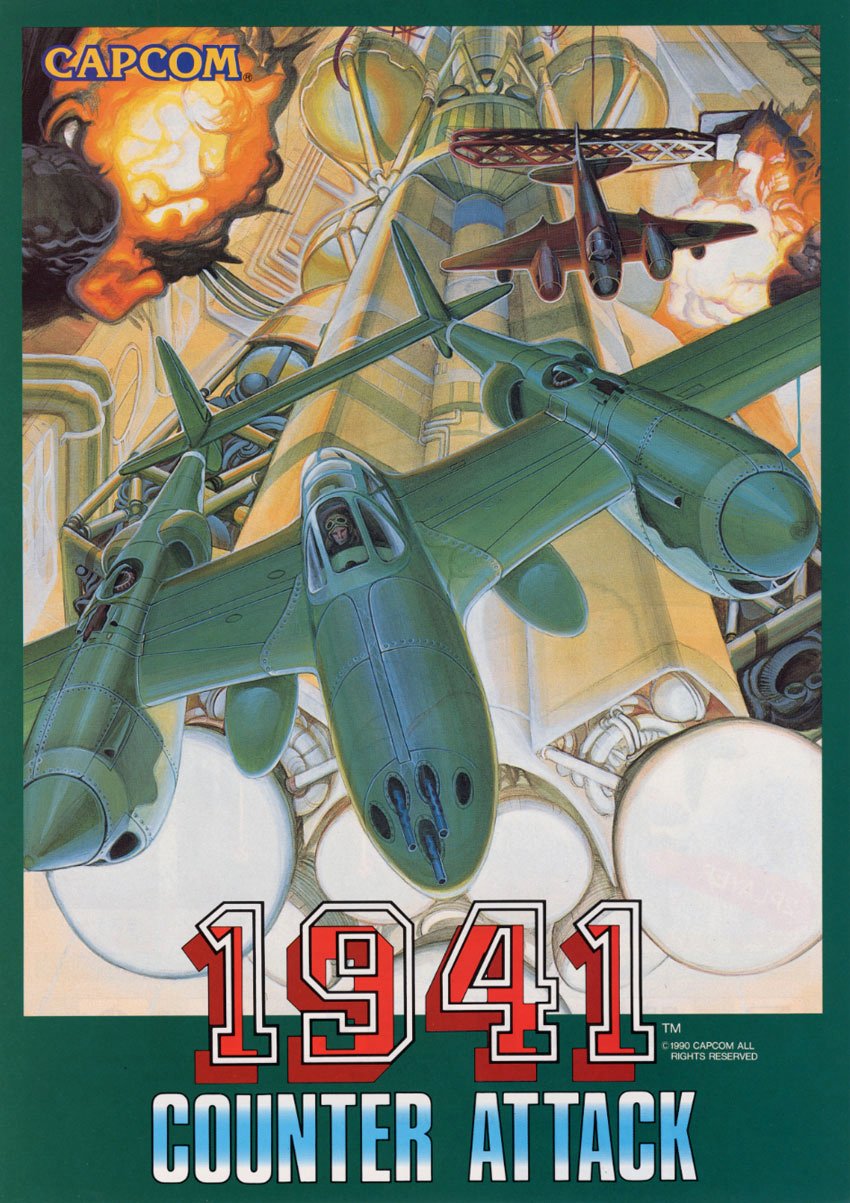
1941反擊戰

這款由 Capcom 於 1990 年在傳奇街機基板 CPS1(Capcom Play System I)上推出的 2D 縱捲軸飛行射擊遊戲《1941 反擊戰》(1941: Counter Attack / 1941 カウンターアタック),是電子遊戲史上將二戰空戰科幻化、硬派彈幕立回與雙人協同作戰融合得最具里程碑意義的射擊神作。作為 Capcom 旗下標誌性二戰射擊「19系列」的第三部正傳(承接《1942》與《1943》),本作全面拋棄了過往舊硬體的極限束縛,憑藉著 CPS1 基板驚人的發色數、流暢無比的立體滾動場景以及首創的雙人合體超必殺技與撞牆判定,在 1990 年代初期的全球街機廳引發了一場前所未有的空戰投幣海嘯。
基本資料與 CPS1 基板下的末日二戰鋼鐵視覺美學: 1990 年正值街機 2D 畫面技術步入黃金全盛期的起點。Capcom 開發團隊利用 CPS1 基板強大的動態處理能力與細膩的點陣像素,將歷史上的二戰戰機進行了充滿科幻感與重量感的硬派改裝。在畫面表現上,本作的戰機動態與爆炸特效流暢得令人屏息。從暴雨傾盆的北大西洋海面、重兵防守的納粹地下要塞、到萬米高空中穿梭於巨型飛空艇的激烈纏鬥,關卡的縱深層次感與動態細節皆達到了當時街機的性能天花板。搭配上融合了軍樂交響與高節奏 FM 音源電子搖滾的熱血背景音樂,本作一在街機廳亮相,其狂放不羈、鋼鐵碰撞感爆棚的視覺衝擊力便令無數玩家為之瘋狂。
劇情背景與虛構二戰「反擊戰」的王牌長征: 在劇情架構上,本作構建了一個將真實歷史大戰與架空科技完美嵌套的鐵血舞台。故事背景設定在 1941 年,一個虛構的二戰平行宇宙中,由邪惡獨裁帝國「拉赫」(Rach,影射納粹德國)所研發出的超科技鋼鐵兵器與巨大要塞橫掃了全球。盟軍在節節敗退的絕望時刻,發動了代號為「Counter Attack」的終極反擊計畫。
玩家所扮演的是盟國最頂尖的王牌飛行員,分別駕駛著美軍傳奇戰機 P-38「閃電」(Lightning)與英軍的 DH-98「蚊式」(Mosquito)。這兩架經過未來科技魔改的戰機,背負著打破帝國封鎖的最後希望,從歐洲戰場的最前線一路逆襲,直擊帝國的核心指揮部。隨著劇情的推進,玩家必須孤軍深入,挑戰體型遮天蔽日的超大型轟炸機、移動金屬要塞以及最終的超級航空母艦,這種將軍人榮譽、鋼鐵咆哮與世界命運完美熔於一爐的宏大敘事,賦予了本作震撼人心的硬派張力。
革命性的血條系統與首創的「撞牆反彈」機制: 在核心操作與機制設計上,《1941 反擊戰》進行了射擊遊戲史上最激進、也最成功的機制創新。遊戲沿用了一個八方向搖桿與兩個動作按鍵(A普通射擊/蓄力、B釋放保險/迴旋)的經典配置,卻大膽打破了當時射擊遊戲「一擊必殺」的死板邏輯,轉而引入了影響後世復古射擊的兩大全新核心機制:
第一,「生命值(Vitality)血條系統」。本作大膽取消了傳統的殘機數設計,改為以一條具備多個格數的血條來呈現戰機的耐打度。玩家的戰機不小心擦撞子彈或與敵機擦身而過時,只會扣除相應的血量,極大地提升了遊戲的容錯率與續航力。更為關鍵的是,當玩家按下 B 鍵釋放能清理全屏彈幕的「Mega Crash」保險時,會直接消耗自身的一格血量,這種將防禦底牌與生命值直接綁定的高風險設計,極大考驗了玩家在關鍵時刻一發逆轉的心理博弈。
第二,「首創的牆壁碰撞與反彈機制」。開發團隊在狹窄的室內或峽谷關卡中,引入了震驚市場的環境物理判定。當玩家的戰機撞擊到兩側的建築牆壁或山崖時,戰機不僅不會爆炸扣血,反而會順應物理慣性產生帥氣的「反彈」位移。在反彈的瞬間,戰機還會獲得短暫的無敵幀,玩家甚至可以利用這個特殊的反彈軌跡來巧妙地躲過密不透風的敵方彈幕,讓原本二維的縱捲軸射擊延伸出了無窮的空間戰術變數。
雙人蓄力合體奧義與大型街機廳的永恆投幣之王: 底層的戰鬥節奏則聚焦於極致的火力宣洩與高速立回。玩家透過按住 A 鍵不放,可以進行「蓄力攻擊(Charge Shot)」,釋放出能瞬間貫穿多架敵機的強力穿透波。在能量與道具系統方面,透過擊毀特定的紅手機編隊,玩家可以拾取多種火力配件,如能擴大攻擊範圍的雙機翼副機(Shatellites),或將子彈變更為三向散彈與強力雷射。
更為驚世駭俗的是本作的雙人聯動機制。當兩位玩家同時將蓄力攻擊充能完畢、並在畫面上橫向靠攏並重疊時,便能觸發本作的終極底牌——「雙人合體超必殺技」。兩架戰機之間會拉出一道威力絕倫的能量閃電,或釋放出漫天飛舞的追蹤彈幕,在瞬間將滿屏的鋼鐵巨獸斬至體無完膚,帶來極致的操作快感與一發逆轉的心理博弈。
《1941 反擊戰》在 1990 年投入街機市場後,立刻以海嘯般的姿態橫掃了全球大型電玩廳,成為整個 CPS1 黃金時代當之無愧的射擊之王。雖然從現代極度嚴謹的平衡性視角來看,本作初代的引擎存在著中後期關卡敵方彈幕密度過高、部分BOSS血量與傷害數值過於狂暴、以及特定連發速度帶來的Bug等缺陷。然而,正是這些「狂野與不完美」,反而賦予了本作一種刀刀見血、命懸一線、驚心動魄的極致競技靈魂。它成功將二戰熱血、大膽的超科技創意與硬核飛行機制完美融合,在整個電子遊戲發展史上,擁有著至高無上、無可替代的巔峰歷史地位。
Released in February 1990 by Capcom for their legendary CPS1 (Capcom Play System I) arcade hardware, 1941: Counter Attack (1941 カウンターアタック) stands as one of the most mechanically innovative, visually thunderous, and structurally definitive masterworks in the history of vertical-scrolling shoot-'em-ups. Operating as the monumental third installment in Capcom’s signature World War II aviation lineage—directly succeeding the foundational blueprints of 1942 and 1943: The Battle of Midway—this masterpiece assumed the responsibility of completely sci-fi-ifying historical aerial combat. Under Capcom's elite 2D sprite engineering team, the title shattered previous hardware constraints, exploiting the dynamic color palettes and heavy sprite-multiplexing capabilities of the CPS1 board. The visual design introduced a raw, industrial aesthetic featuring meticulously pixelated, heavily armored fictional variations of iconic historical aircraft. Setting these war machines against multi-layered scrolling backdrops—ranging from rain-slicked Atlantic sea lanes and heavily fortified subterranean Nazi battlements to high-altitude engagements weaving through colossal airborne battleships—and backing them with a driving FM-synthesis military-march rock score, the cabinet injected an unprecedented level of adrenaline that immediately commanded top coin-intake charts across global amusement centers.
Plot and the Iron-Clad Campaign of Parallel World War II
The narrative framework of 1941: Counter Attack departs from strict historical records to construct a grim, high-stakes parallel universe set in the titular year of 1941. The overarching lore dictates that an oppressive, ultra-technological militaristic empire known as the "Rach" (a direct, thinly veiled analogue to Nazi Germany) has successfully unleashed a global blitzkrieg powered by massive walking land cruisers, screen-filling heavy bombers, and mechanized fortresses, systematically breaking the resistance of Allied forces. Pushed to the brink of absolute capitulation, the Allied high command authorizes a desperate, all-or-nothing offensive operation code-named "Counter Attack."
The campaign centers on two elite wing commanders chosen to break the enemy's geopolitical stranglehold, piloting heavily modified tactical iterations of the American P-38 Lightning and the British DH-98 Mosquito. Outfitted with experimental futuristic weaponry, these dual fighters must carve a devastating path directly through the vanguard of the Rach empire across Europe, targeting the regime's core military hierarchy. The progression maintains an intensely heroic tone, forcing players to execute relentless tactical sorties against overwhelming mechanical leviathans—culminating in a spectacular assault on a supreme super-dreadnought aircraft carrier—weaving military honor and high-density bullet dodging into a powerful interactive epic.
Gameplay Mechanics and the Revolution of the Vitality Bar System
In terms of structural interface and physical execution, the arcade configuration preserves the definitive layout of an eight-way directional joystick paired with two primary action inputs for weapon firing/charging and megacrash activation, yet it permanently altered the survival philosophy of the genre by introducing a radical, high-priority Vitality bar system. Moving completely away from the traditional, unforgiving "one-hit-kill" architecture that dominated contemporary arcade shooters, the 1990 engine equipped players with a segmented life reservoir. Suffering a direct hit from enemy munitions, colliding with lesser aerial combatants, or grazing a boss's armor would only deplete specific increments of the health bar rather than instantly destroying the aircraft, substantially extending the strategic endurance and pacing of a single credit.
Crucially, this health metric was directly intertwined with the game's ultimate defensive panic button: the Mega Crash. Activating this clearing shockwave instantly dissolved all screen-active bullet matrices and dealt severe area-of-effect damage, but penalized the player by consuming one exact segment of their active health pool. This brilliant mechanical loop transformed passive defense into a constant, high-stakes psychological trade, forcing players to calculate whether sacrificing raw health for immediate screen security was worth the tactical risk in the heat of a high-density barrage.
Spatial Manipulation, Weapon Saturation, and Co-Op Cohesion
The true mechanical crown jewel of 1941: Counter Attack lies within its brilliant, unprecedented implementation of environmental wall-collision physics. In stark contrast to every other vertical scroller of the era, where brushing against a solid background wall resulted in instantaneous death, the engine treated solid cliffs, concrete tunnels, and base walls as physical boundaries. Crashing laterally into these structures caused the player's fighter to seamlessly bounce off the surface according to precise momentum trajectories. During this rich bounce animation, the aircraft was granted a brief window of absolute invincibility frames. High-level tournament players quickly learned to actively weaponize this mechanic, deliberately slam-reflecting their fighters off cavern walls to phase completely through otherwise unavoidable, screen-saturating bullet patterns, adding a brilliant dimension of spatial geometry to the neutral play.
Primary offense utilized a highly responsive charge-shot system; holding the primary fire button saturated an energy meter that, when released, unleashed a devastating, multi-hitting pierce wave capable of tearing straight through columns of heavy interceptors. Weapon progression relied on intercepting specific red-colored squadron formations to harvest dynamic sub-weapon attachments, including the iconic wing-side Shatellites for wider coverage, high-frequency three-way spread patterns, and ultra-dense piercing lasers.
This tactical complexity achieved absolute cohesion during two-player synchronous play through a hidden cooperative charge mechanic. When both players simultaneously held their charge commands to maximum saturation and physically aligned their aircraft on a horizontal axis, they triggered a devastating dual-link hyper assault. This action generated an immense, screen-clearing web of lightning energy between the two planes or discharged a relentless torrent of high-damage homing missiles, obliterating everything in its trajectory. Long after the golden era of CPS1 hardware has concluded, 1941: Counter Attack remains an absolute monument to early-90s arcade design, standing permanently enshrined as an unshakeable milestone of technical shooter history.
運費計算方式:
貨款滿1000元運費外加90元
貨款1000以下:買1件運費外加 60元,買2件運費外加 70元,
買3件運費外加 80元 ,買4件運費外加 90元
貨到付款外加30元手續費
外島及大陸地區運費另計
付款方式:
線上刷卡:本站採用Paypal線上刷卡
虛擬帳號匯款:屬於您專屬的虛擬帳戶,方便站長查帳使用,本站強力推薦
實體ATM匯款:請將匯款帳號記錄下來至各大銀行ATM提款機轉帳
超商條碼繳費:請列印本站提供的條碼至四大超商繳費
線上轉帳:透過玉山銀行線上ATM轉帳(此系統只支援IE瀏覽器)
貨到付款:本站採用黑貓宅急便貨到付款
其他注意事項:
如需購買線上點數卡請直接跟站長連絡,本站不提供點數卡的線上付款