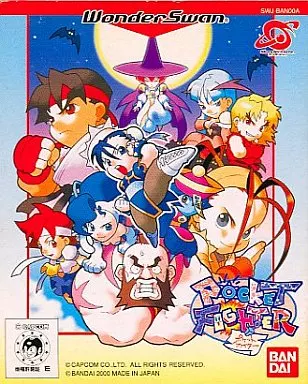
口袋格鬥 / 袖珍快打
《口袋格鬥》是卡普空於1997年在街機推出的2D對戰格鬥遊戲,以大幅Q版化、二頭身風格的角色為最大特色。它源自《Super Puzzle Fighter IIX》的chibi美術設定,將眾多卡普空旗下的招牌格鬥角色重新塑造成可愛又誇張的小型造型,並置於充滿惡搞、幽默、卡通節奏感的平行世界中。角色在對戰中會不斷變裝、搞怪、甚至跳出其他作品的致敬元素,使整體風格輕鬆又富於戲劇效果。
在當年的遊戲雜誌《Gamest》年度大賞中,本作受到高度肯定,不僅取得總評第 12 名,更拿下最佳格鬥遊戲第8名與演出獎第3名,角色火引彈與春日野櫻還分別獲得角色獎項,充分展現其高人氣。
沒有嚴謹的劇情主線,而是將各系列的角色匯聚在同一個卡通化平行世界中展開各種風格搞怪的對戰。每位角色的對話、勝利演出與連段變身都帶有強烈的喜劇效果,例如春麗會突然變成清潔婦打掃地板、Felicia會化身成新聞主播、櫻甚至會換上校服揮舞掃把,讓每一場對戰都像是一場帶有惡搞精神的小型舞台劇。
原本就擁有鮮明性格的角色,經過Q版化後變得更加誇張、幽默,呈現出與《街頭快打》或《吸血鬼獵人》截然不同的輕鬆氣氛。採用簡化後的操作系統,只需方向桿與三顆按鍵(拳、腳、特殊)即可完成所有攻擊與必殺技。沒有強弱攻擊之分,不同動作皆依靠方向輸入與按鍵組合來觸發。尤其是「特殊鍵(S)」極為關鍵,負責許多角色的核心技、特殊動作,甚至部分超必殺技的輸入。
最具代表性的設計是「寶石強化系統」。角色的三種主要必殺技分別對應紅、黃、藍三色寶石,只要在戰鬥中收集寶石,就能提升其相應招式的等級。寶石會在攻擊、受擊、打破寶箱或擊中道具運輸機時掉落,寶石越大補充量越高。隨著招式升級,角色的火力、速度與壓制力會大幅提升,甚至能施展威力驚人的超大型連段「Mighty Combo」。除了攻防,本作還加入「搶寶石」的戰術思維。甚至有玩家刻意不撿某種寶石,藉此讓特定招式維持在較有利的等級,形成不同的對戰深度。
本作最具娛樂性的內容,就是角色會在連段中不斷變裝。只要以站立拳作為起手,就能自動進入Flash Combo。角色會在攻擊過程中化身為忍者、運動員、甚至cos 其他卡普空角色,呈現各種夸張且快節奏的連段動畫。第四段攻擊還會擊出寶箱,為戰局增加更多變化。Flash Combo的節奏、動畫細節與搞怪變裝,是整款遊戲最具辨識度的招牌特色。
因為本作沒有一般格鬥遊戲的「削血傷害」,若想打破對方的防禦,就必須使用S鍵發動的Guard Crush技。這種招式能直接破防並讓對手掉落寶石,但起手較慢,因此通常必須在對手出招硬直或破綻較大時使用。遊戲也提供破防後的反制系統,避免一方被無限壓制,使對戰保持流暢與平衡。
《口袋格鬥》也曾被移植Bandai的WonderSwan上,但因硬體限制相當顯著,與街機或PS1版相比差異明顯。WS採用單色螢幕,因此彩色寶石無法以顏色辨識,只能以形狀識別,例如方形代表紅、菱形代表黃、圓形代表藍。然而灰階畫面加上小螢幕,讓寶石辨識變得相當困難。
WS的特殊鍵被安排在方向鍵上方,少了實體按鍵的觸感,使得瞬時反應如閃避與反擊變得較難操作。加上移植版本刪除許多原作的語音、道具演出和部分動畫細節,甚至沒有自動存檔功能,需要手動進入選項儲存。不過,令人意外的是,WS版的動畫流暢度依然相當高,角色動作表現得十分完整。在掌機格鬥遊戲中,可說是表現優異的作品,而《口袋格鬥》本身的Q版造型也非常適合在小螢幕上呈現,不會像其他精細格鬥遊戲被縮小後變得模糊。
WS 版還增加「卡片收集模式」與「卡片對戰模式」,但由於說明全為日文,加上部分隨機性,讓玩法更具挑戰。此外,當年的WonderGate線上功能也能用來解鎖額外內容,只是目前已全面停止服務。整體而言,WS版展現出十足誠意,但受限於硬體性能,終究屬於「努力還原但無法完全重現」的移植作品。
《口袋格鬥》在各平台上都獲得普遍好評。它不像一般傳統格鬥遊戲那麼硬派,而是將娛樂性、變裝、搞怪與角色魅力融合成一個輕鬆易上手、卻又不失深度的獨特作品。對新手來說操作簡單易懂;對老玩家而言寶石強化與連段系統仍有足夠研究空間。再加上誇張的動畫節奏與幽默風格,使它在卡普空格鬥遊戲中自成一格。至於WonderSwan版本,玩家普遍認為移植用心,但受到單色畫面、按鍵配置、音效刪減等限制,無法完整呈現原作的魅力。不過在當時的掌機格鬥遊戲中,它仍然算是品質不錯的作品,只是硬體條件限制其發揮空間。
Pocket Fighter is a 2D versus fighting game released by Capcom in arcades in 1997. Its most prominent feature is the heavily super-deformed, two-head-tall chibi-style character designs. Derived from the chibi aesthetic of Super Puzzle Fighter IIX, the game reimagines many of Capcom’s iconic fighting characters as cute, exaggerated mini versions of themselves, placing them into a humorous, parody-filled, cartoon-like parallel world. During battles, characters constantly change costumes, behave comically, or reference other Capcom titles, giving the game a playful and theatrical style.
The game received strong recognition in that year’s Gamest Awards, ranking 12th overall, 8th in Best Fighting Game, and 3rd in Best Presentation. Characters Hsien-Ko (Lei-Lei) and Sakura Kasugano also won character awards, reflecting the title’s popularity.
There is no strict overarching storyline; instead, characters from different series gather in a cartoonish parallel world to engage in whimsical, comedic battles. Each character’s dialogue, victory animation, and mid-combo transformations feature strong comedic flair. For example, Chun-Li might suddenly turn into a janitor mopping the floor, Felicia becomes a news anchor, and Sakura may put on her school uniform and swing a broom—making each match feel like a miniature comedic stage show.
Characters, already iconic in personality, become even more exaggerated and humorous after being chibi-fied, creating a laid-back atmosphere very different from Street Fighter or Darkstalkers. The game uses a simplified control scheme with a joystick and three buttons (Punch, Kick, Special), which cover all actions and special moves. There are no light/medium/heavy distinctions; moves are triggered through directional inputs combined with buttons. The Special (S) button is especially important, handling core moves, unique actions, and certain super moves.
The game’s most defining system is the Gem Power-Up System. Each character’s three main special moves correspond to red, yellow, and blue gems. Collecting gems during battle increases the strength of the associated move. Gems drop when attacking, getting hit, breaking treasure chests, or striking the item-carrying transport machine. Larger gems grant more power. As moves level up, characters gain more firepower, speed, and pressure capability, and can execute devastating extended combos called Mighty Combos. Strategic “gem denial” is also possible—some players intentionally avoid picking certain gems to keep specific moves at advantageous levels, adding depth to competitive play.
One of the game’s most entertaining features is the costume-changing Flash Combo system. By initiating with a standing punch, characters enter an automatic combo sequence. During these combos, they transform into ninjas, athletes, or cosplay various Capcom characters, all through fast-paced, over-the-top animations. The fourth hit produces a treasure chest, further affecting the match. These flashy, humorous transformations are among the game’s most recognizable elements.
Since the game lacks traditional “chip damage,” breaking an opponent’s guard requires using S-button Guard Crush moves. These attacks break defense and cause the opponent to drop gems, but they have slow startup, so they must be used when the opponent is vulnerable. A post-crush counter system also prevents one-sided pressure, keeping matches balanced and fluid.
The game was also ported to Bandai’s WonderSwan, though the hardware limitations were significant compared with the arcade and PS1 versions. The WS has a monochrome screen, so colored gems are instead indicated by shapes—square for red, diamond for yellow, circle for blue. However, distinguishing them on a small grayscale screen can be difficult.
The WS’s Special button is placed above the D-pad, making it less responsive for quick reactions such as dodging or countering. The port also removes many voices, item animations, and other visual details. It lacks autosave, requiring manual saving via the options menu. Surprisingly, character animations remain smooth, and the chibi art style fits well on the small display—more so than other detailed fighting games that become blurry when scaled down.
The WS version adds a Card Collection Mode and Card Battle Mode, though the instructions are entirely in Japanese and involve some randomness, adding complexity. WonderGate online features were once usable to unlock extras, though the service has long ended. Overall, the WS port shows strong effort but, due to hardware limits, cannot fully replicate the original experience.
Across platforms, Pocket Fighter received largely positive reviews. It is not a hardcore fighting game; instead, it blends entertainment, transformations, humor, and character charm into a unique experience that is easy to pick up yet has meaningful depth. New players can quickly understand the controls, while veterans can still explore gem optimization and combo systems. The exaggerated animations and comedic style make it stand out among Capcom’s fighting titles.
As for the WonderSwan version, players generally appreciate the effort, but limitations such as the monochrome screen, button layout, and reduced audio/visual content prevent it from fully conveying the original’s charm. Even so, among handheld fighting games of its era, it remains one of the more impressive entries, held back only by the system’s capabilities.
運費計算方式:
貨款滿1000元運費外加90元
貨款1000以下:買1件運費外加 60元,買2件運費外加 70元,
買3件運費外加 80元 ,買4件運費外加 90元
貨到付款外加30元手續費
外島及大陸地區運費另計
付款方式:
線上刷卡:本站採用Paypal線上刷卡
虛擬帳號匯款:屬於您專屬的虛擬帳戶,方便站長查帳使用,本站強力推薦
實體ATM匯款:請將匯款帳號記錄下來至各大銀行ATM提款機轉帳
超商條碼繳費:請列印本站提供的條碼至四大超商繳費
線上轉帳:透過玉山銀行線上ATM轉帳(此系統只支援IE瀏覽器)
貨到付款:本站採用黑貓宅急便貨到付款
其他注意事項:
如需購買線上點數卡請直接跟站長連絡,本站不提供點數卡的線上付款
-
口袋格鬥 / 袖珍快打
- 定 價: 4,180円
- 售 價: 0.00
- 庫存量: 0 套
- 已賣出: 0 套
 人氣指數: 0.3 / 6 顆星