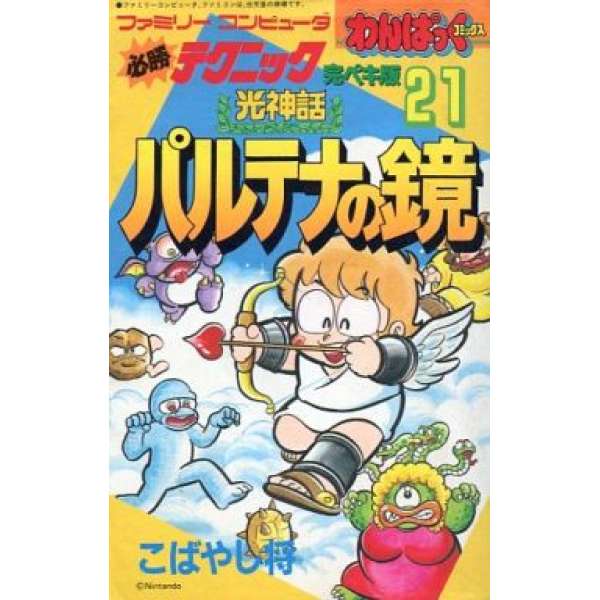
FC 必勝完全攻略版21 光神話 帕爾提娜之鏡
 1987-03-20
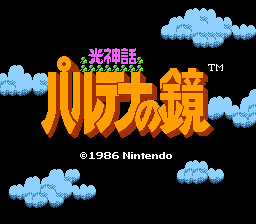
《光神話:帕爾提娜之鏡》(Kid Icarus)是任天堂於1986年在Famicom Disk System推出的動作冒險遊戲,隔年又在北美與歐洲推出NES卡帶版本。以希臘神話為核心靈感,融合高難度平台動作、射擊、迷宮探索、角色成長與大量惡搞幽默,形成一個風格獨特、極富生命力的世界觀。雖然在當時並非任天堂的超級大作,但憑藉其新穎的系統與個性鮮明的演出,逐漸成為玩家間津津樂道的經典。
舞台位於「天使之國」(Angel Land),由光之女神帕爾提娜與闇之女神梅杜莎共同統治。然而,梅杜莎因殘酷虐待人類而觸怒帕爾提娜,被變成醜陋的怪物並逐出冥府深處。心懷怨恨的她率領冥府魔軍反攻天界,奪走了維護世界平衡的「三種神器」,成功推翻帕爾提娜並將其囚禁。
女神在最後的力量逐漸消逝之前,解放被囚於冥府監牢、尚無法飛翔的天使戰士「皮特」。她交予他弓箭並下達最後的希望:奪回三種神器,打倒梅杜莎,拯救天使之國。於是,皮特踏上從冥府界到地上界,再一路攀向天空界的冒險旅程。看似輕快又略帶喜劇色彩的外表下,其背後卻是一段忠誠與重生的英雄神話。
主要以跳躍與弓箭射擊作為核心操作。以十字鍵控制左右移動,A鍵跳躍,B鍵射箭,按住上方向可向上射擊。雖然操作簡單,但角色具有較大的慣性,落地時容易因滑移而跌落,成為遊戲高難度的原因之一。弓箭射程短,必須靠近敵人才能命中,使戰鬥節奏緊湊刺激。砦關(迷宮)中可使用道具「鐵鎚」,威力強大但屬消耗品,專門用來打碎石像救出被石化的「イカロス」同伴,讓他們在Boss戰中提供短暫支援。
最顯著的特色之一,是加入RPG式成長系統。敵人掉落的「心」既是貨幣又是得分來源,得分達標後可提升最大生命值;若在神殿獲得足夠的評價,還能讓弓箭強化。這讓《光神話》不只是動作遊戲,也具有明顯的修行與冒險感。遊戲共分為四個主要區域,每個區域展現不同的遊戲風格。
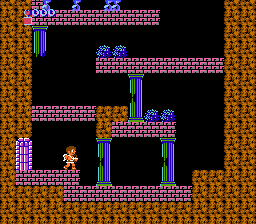
「冥府界」與「天空界」皆為縱向卷軸,需要一層一層往上跳,如《敲冰塊》(Ice Climber),並且具備從畫面左右邊緣相互連接的特性。這兩個關卡因大量狹窄平台而被稱為新手殺手,只要落出畫面下緣就會立即死亡,形成極高難度。
「地上界」採用較傳統的橫向卷軸形式,像《超級瑪利歐兄弟》,玩家以穩定節奏前進即可。敵人配置相對友善,使這區域成為眾多玩家認為最輕鬆的關卡。
每一界的第四階段則為大型要塞迷宮,需要使用地圖、鉛筆、火把等道具逐步探索。這些迷宮類似《薩爾達傳說》初代設計,需在固定畫面中找路、找Boss、解救夥伴,再奪回三種神器之一。最終的「天空神殿」完全改變遊戲玩法。當集齊三種神器後便能自由飛行,整個關卡變成橫向射擊遊戲,與《惡魔城》與《星之卡比》同世代的動作遊戲相比,這是極具突破性的玩法切換。
雖使用當時常見的8-bit圖像,但角色設計和敵人造型具強烈辨識度。希臘神話背景搭配大量惡搞,又包含陰森冥府、清朗天空界、散佈陷阱的迷宮等,營造出一種荒誕卻引人入勝的冒險氛圍。音樂由田中宏和創作,是遊戲獲得高度讚譽的一大原因。特別是第一關的進行曲式主題,被視為系列象徵性旋律,旋律明亮、節奏感強,為高難度開局帶來一種奇妙的希望感。
《光神話》最吸引人的地方之一,是其大量惡搞演出:皮特變成「茄子」後必須去醫院治療,因為「茄子(ナス)」與「護士(ナース)」是日文雙關;死神登場時會播放滑稽音效,與其可怕外觀形成反差;商店可用2P麥克風對老闆大喊讓他降價,但若喊得太大聲反而會被怒罵而加價;壞結局竟然讓皮特變成戴鼻眼鏡的怪物「メガネハナーン」。這些荒唐又無傷大雅的幽默,塑造充滿個性的《光神話》世界,使玩家即便在高難度死亡無數次後仍能莞爾一笑。
Disk System的銷量整體不如Famicom卡帶市場,但本作在其平台上屬於討論度極高的作品之一。雖然難度常被抱怨過於不友善,但整體的舞台設計、BGM、迷宮探索、RPG要素等都展現任天堂早期開發的巧思。海外版本推出後更提升其知名度,而在多年後,《新.光神話:帕爾提娜之鏡》(3DS, 2012)的誕生才使得整個系列獲得新生。本作也因其獨特性、難度與幽默再度被玩家重新評價,被視為8-bit時代極具代表性的動作冒險作品之一。
Kid Icarus—originally released by Nintendo for the Famicom Disk System in 1986 and later issued as a NES cartridge in North America and Europe—is an action-adventure game that blends Greek-mythology-inspired motifs with challenging platforming, shooting mechanics, dungeon exploration, RPG-style growth, and an abundance of quirky humor. Although it was not positioned as a major Nintendo flagship title at the time, its originality and distinct personality gradually earned it lasting recognition among players.
The story takes place in Angel Land, a realm once jointly ruled by Palutena, the Goddess of Light, and Medusa, the Goddess of Darkness. Medusa’s cruelty toward humans enraged Palutena, who transformed her into a hideous monster and banished her to the depths of the Underworld. Filled with resentment, Medusa rallied the forces of darkness, overthrew Palutena, stole the Three Sacred Treasures, and plunged Angel Land into chaos.
With her power nearly depleted, Palutena frees Pit, a young angel and captain of her guard who had been imprisoned in the Underworld and is unable to fly. She grants him a bow and entrusts him with her final hope: reclaim the Three Sacred Treasures, defeat Medusa, and save Angel Land. Thus begins Pit’s journey—from the Underworld, across the surface world, and finally ascending into the heavens. Beneath its lighthearted and occasionally comedic exterior lies a tale of loyalty, rebirth, and heroism.
The core gameplay revolves around platform jumping and bow-and-arrow combat. The D-pad controls movement; the A button is for jumping; the B button fires arrows; pressing upward allows upward shots. Despite the simple controls, Pit’s pronounced momentum causes him to slide slightly upon landing, making platforming hazardous and contributing to the game’s notorious difficulty. The bow’s short range forces players to get close to enemies, keeping battles tense. In fortress stages, Pit can use the Hammer, a powerful consumable tool used to smash statues and rescue petrified Icarus allies, who will assist briefly during boss fights.
One of the game’s most distinctive features is its RPG-like progression system. Defeated enemies drop hearts, which function both as currency and score; reaching certain score thresholds increases maximum health, while high performance in the Sacred Training Rooms strengthens Pit’s arrows. This gives the game a sense of growth and adventure uncommon in its era.
The game is divided into four major regions, each with its own gameplay style:
- The Underworld and Skyworld use vertical scrolling reminiscent of Ice Climber, requiring players to ascend layer by layer. Their narrow platforms and instant-death falls make them infamous difficulty spikes. Falling off the bottom of the screen results in immediate death.
- The Overworld adopts the more traditional horizontal scrolling of Super Mario Bros., offering steadier pacing and relatively forgiving enemy layouts, making it the most relaxed portion of the game.
- The fortresses at the end of each region function as large mazes similar to the dungeons in The Legend of Zelda. Players must acquire maps, pencils, and torches to navigate the fixed-screen labyrinths, rescue allies, and defeat the guardian to recover one of the Three Sacred Treasures.
The final area, the Sky Temple, drastically shifts genres. Once all three treasures are gathered, Pit gains the ability to fly freely, turning the entire stage into a side-scrolling shooter. This bold shift in gameplay was remarkably innovative for its time.
Despite its 8-bit visuals, the character designs are memorable and vivid. The world blends Greek myth with absurd humor: eerie Underworld caverns, bright and hopeful Skyworld terrain, trap-laden fortresses, and a mischievous tone that gives the adventure its unique charm. The soundtrack, composed by Hirokazu Tanaka, remains one of the most praised aspects of the game. The marching-style theme of Stage 1 is particularly iconic, symbolizing the entire series with its bright, optimistic melody.
One of the game’s most beloved qualities is its quirky humor. Pit can be cursed into an “eggplant” and must visit a hospital to recover—a pun in Japanese between nasu (eggplant) and nurse. The menacing Reaper triggers a silly alert tune when spotting Pit. Players can shout into the second-controller microphone to negotiate prices with shopkeepers, though yelling too loudly can cause prices to rise instead. The bad ending comically transforms Pit into the bizarre “Melon-Hane”–style monster with fake glasses and nose. Such endearing absurdity infuses Kid Icarus with a sense of personality that keeps players smiling even through its harshest challenges.
While the Disk System never achieved the widespread commercial success of the Famicom cartridge market, Kid Icarus was one of its most talked-about titles. Its difficulty is often criticized as unfriendly, yet its clever level design, music, dungeon exploration, and RPG elements demonstrate Nintendo’s early creative experimentation. The NES release helped expand its popularity overseas, and decades later, Kid Icarus: Uprising (3DS, 2012) revived the franchise for a new generation.
Today, the original Kid Icarus is re-evaluated as a representative classic of the 8-bit era—distinctive, challenging, humorous, and rich with imaginative design.
運費計算方式:
貨款滿1000元運費外加90元
貨款1000以下:買1件運費外加 60元,買2件運費外加 70元,
買3件運費外加 80元 ,買4件運費外加 90元
貨到付款外加30元手續費
外島及大陸地區運費另計
付款方式:
線上刷卡:本站採用Paypal線上刷卡
虛擬帳號匯款:屬於您專屬的虛擬帳戶,方便站長查帳使用,本站強力推薦
實體ATM匯款:請將匯款帳號記錄下來至各大銀行ATM提款機轉帳
超商條碼繳費:請列印本站提供的條碼至四大超商繳費
線上轉帳:透過玉山銀行線上ATM轉帳(此系統只支援IE瀏覽器)
貨到付款:本站採用黑貓宅急便貨到付款
其他注意事項:
如需購買線上點數卡請直接跟站長連絡,本站不提供點數卡的線上付款
-
FC 必勝完全攻略版21 光神話 帕爾提娜之鏡
- 定 價: 387円
- 售 價: 0.00
- 庫存量: 0 套
- 已賣出: 0 套
人氣指數: 0 / 6 顆星